Showing posts with label weather underground. Show all posts

Monday, October 13, 2014

Three keys to better hunting and fishing

If you're like a lot of people you're struggling to sit in your treestand right now.  While there's a part of you that waits all year for a chance to hunt, there's a whole nother part that can't tear away from the incredible fishing that's happening right now as the fall feeding frenzy sweeps across the country.  Whether you're after bass, pike, trout, or panfish; it's safe to say that the best fishing you've seen all year is underway (or about to be).  But lucky for you, there are things you can do while you're in your favorite tree that will not only make you a better hunter, but that will improve your fishing trips as well.

To begin with, you need to be sharp and remain still.  Keeping your movements to a minimum will reduce noise and the chances of being seen.  A great way to do that is to have a smartphone and two apps:  Weather Underground and Fishidy.  Weather Underground is essential for several reasons.  It has doppler radar that will show you if a storm is tracking in your precise location, so you can be sure that you're safety isn't in question (that's always a great place to start).  WU also pulls data from millions of weather stations all over the globe, so you can be sure to get predictions for the week that are as close as possible to where you're planning to be.  I can't tell you how many times I've had people tell me "weather I hadn't anticipated ruined my trip".  This app will absolutely reduce that risk.

Fishidy is what's going to keep you engaged all day long.  With thousands of bodies of water to research and a community of anglers that grows every day, there's an unlimited amount of information at your fingertips.  Let's say you just found out that your cousin is getting married in Michigan next summer and you're gonna be there for a week and want to fish Lake St. Claire while you're there.  You can see hotspots, depths and contour lines, vegetation, places to launch, and detailed information from users on fish they've caught and what they caught them on (pictures included).  You can also subscribe to allow you to receive notification of future updates posted to that specific body of water.  This is a great way to research your trips.  Don't want to share your catches with everyone?  That's ok too.  You can adjust your settings so that you're trophies are visible to only you.


Fishidy is also a great way to take a closer look at places you're very familiar with.  Lakes and rivers are often changing, and there are many times when you'll catch a fish someplace where you didn't think you would.  Maybe it's a certain depth, or a transition area that you didn't notice before.  Now you can go and find other areas like that one and have some new places to check the next time you go out.  Imagine how closely you can examine a body of water while you're sitting uninterrupted in a tree for 12 hours.  It's hard to find the time to do that under normal circumstances, and even when have the time it's difficult to force yourself to do it.

Now I know that some people are saying "no way my battery will last that long".  You're right.  No cell phone battery will let you look at something with screen resolution that high for 12 hours.  But Snowlizard has a case called that SLXtreme that will protect your phone and charge it.  The case is completely submersible, and has a strap attachment (below) that will not only make it float if you drop it in water but it also acts as a pad so you can wear it around your neck without it being uncomfortable when you need to be instantly hands free.  But the real advantage to this case is the battery power.  When your cell phone is about to die, simply press the button on the back of the case and it will charge your battery back to full while you use it.  The four lights on the back will tell you how much power the case has to give (4 lights equals a fully charged case).  My SLXtreme has fully charged my iPhone 5 twice on one full charge, more than enough battery life to keep me doing research all day.  And if that's not enough, there's even a solar panel on the back of the case that will charge it in the sun.  The SLXtreme is available to smart phones as well as tablets, so you're covered no matter what you decide to use.


The last thing you need is to be sure to be warm and dry.  I wear my Stormr Stealth gear and it gives me everything I need from a camo suit.  I'm warm and dry, the Real Tree Max4 blends into any background regardless if I'm hunting trophy whitetails or geese, it's also dead quite so I can draw my bow without fear of being heard like other noisier jackets.


So there you have it.  You're a hunting and fishing, weatherproof ninja ready to take on the outdoor world and staying one step ahead of the competition.

Sunday, October 5, 2014

Reel Weather visit NYPENN Girl Scouts of America Amahami Festival.

Never let anyone tell you that our future is in jeopardy when referencing our youth.


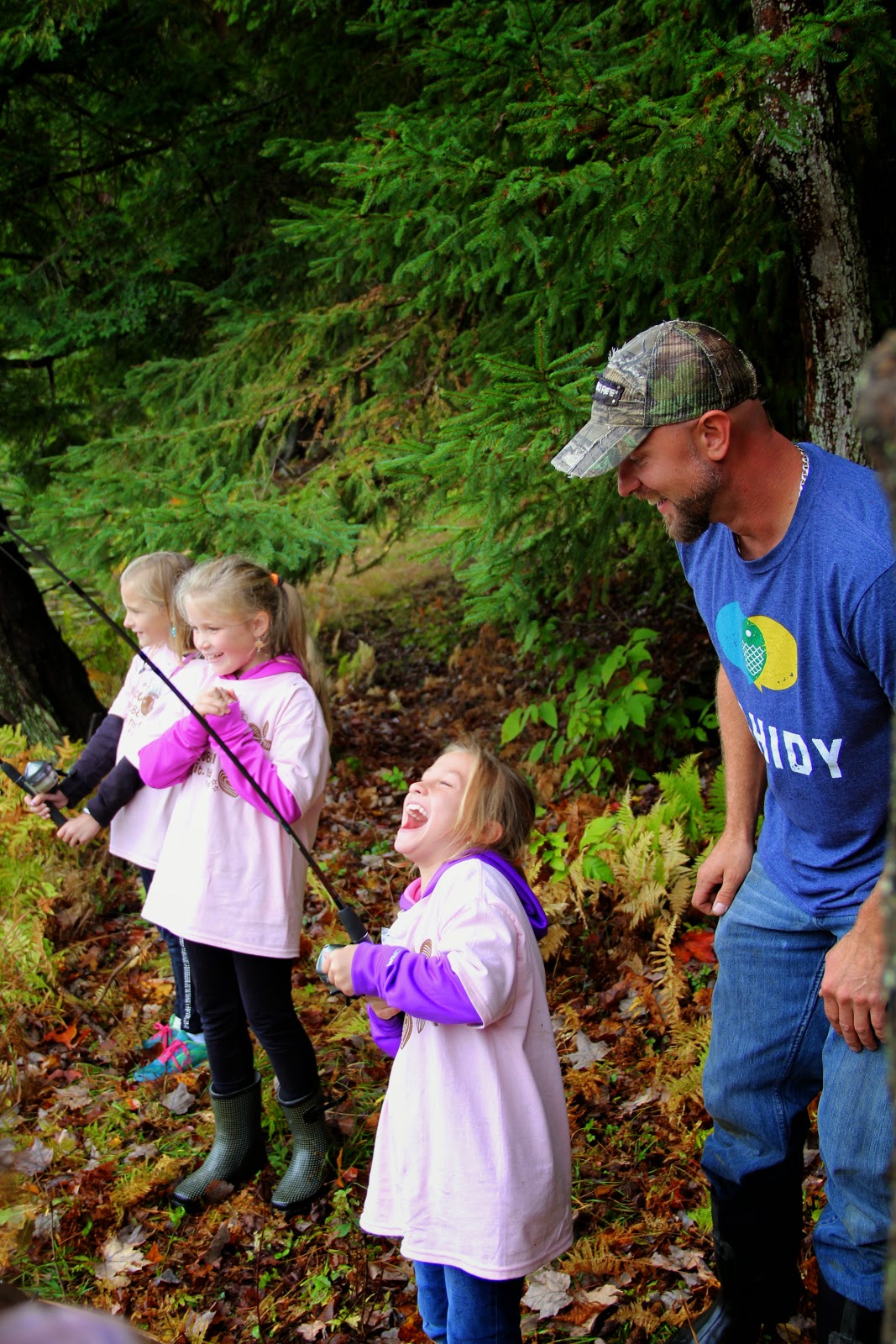
This weekend I had the absolute privilege of attending the NYPENN Girl Scouts of America's Amahami Festival as a presenter on weather, fishing, and environmental stewardship.  Despite the cooler weather and early rain showers, over 200 people turned out to participate, making it the largest attended in the history of Amahami.  Being that this was my first time ever attending an event with the Girl Scouts, I had no idea what to expect.  Thankfully I had the help of fellow anglers John Malzahn and his son Michael, Dan Drake, and Dominic Sergi.  Together, these guys all did an amazing job of helping me bring Reel Weather to Deposit NY.

Who loves Weather Underground?

We began with one group of about 15 young girls.  To start we spoke about the importance of taking care of our environment, keeping our lakes, rivers, and forests free from pollution.  Then I talked about the most basic ways that weather impacts fishing, and why that's valuable, while showing my personal weather station.  I then moved to our lure selection for the day, which consisted of wacky hooks from Lazer Trokar, and Gary Yamamoto Senkos, with a demonstration on how to use this application and why it works.  After that we broke into four groups, and Dominic, Dan, John, Michael, and myself spread out across the lake to apply what we had just learned.

In no time the girls were catching fish, and all across the lake you could hear the sound of them screaming for joy.  For many, these are the first fish they've ever caught, and the first wild fish they've ever seen.  They're learning how to touch them properly, how to release them, how old they are, and why it's important to practice catch and release.  For example, a largemouth bass in NY that weighs over 5 pounds will get people's attention.  It's what's considered by those who fish a lot to be a "good fish".  That fish would be over 10 years old.  Being that bass aren't generally considered to be a delicacy, there are more reasons to keep them alive than to harvest them.


When we got back to our station and said farewell to our first group, we learned we had three more groups waiting.  By 2 we had over 50 kids fishing on the shore at once, having spent all day with over 150 young girls.  These wonderful kids were the most respective, attentive, and polite I'd ever worked with.  They were all environmentally conscious before we even began, and it was so refreshing to see and hear so many kids understand the importance of protecting our resources.  It was a testament to the NYPENN Girl Scouts of America, and to the parents of those kids, who are largely responsible for having raised such wonderful girls.  By all accounts, we were a huge hit there, and I hope that they invite us back.  Thanks again to all my friends for helping, and to Trokar, Dobyns, Fishidy, and Weather Underground.


Friday, September 19, 2014

Day 2 of Bassmaster Elite Series AOY Tourney at Escanaba cancelled.

Looks like that wind I warned people about in my Fantasy Fishing post earlier this week came a day early, postponing things for a day.  So what impact will that have on the event, and what of the days to come?
The small craft advisory that was initially posted this morning will be lifted late afternoon/early evening Saturday.  For those of you who aren't sure what a Small Craft Advisory is, here's the definition and advisory itself as stated at Weather Underground:
...Small Craft Advisory remains in effect from 8 am this morning to 3 PM EDT Saturday...
A Small Craft Advisory remains in effect from 8 am this morning to 3 PM EDT Saturday.
* Wind and waves during the small craft advisory: expect sustained winds of up to 25 knots from the south...with gusts up to 33 knots. The largest expected significant waves will be 8 feet with a maximum wave height of up to 11 feet possible.
* Timing: the maximum winds are expected around 4 PM EDT Friday with the largest waves expected around 11 PM EDT Friday.
Please see the latest marine forecasts for more detailed information.
Precautionary/preparedness actions...
A Small Craft Advisory means that wind speeds of 22 to 33 knots are expected to produce hazardous wave conditions to small craft. Inexperienced mariners...especially those operating smaller vessels should avoid navigating in these conditions.
​That certainly puts things into perspective, doesn't it?
If anglers aren't allowed back out until Sunday, expect a much tougher bite as temperatures are forecasted to plummet with lows approaching the 30s and high of only 57.  That's quite different from the weather they've been fishing in.  I think it's safe to say that you'll still see a couple guys with 20, but that cold snap makes me skeptical of anyone bagging 25.

For updated Marine forecasts at Escanaba you can go here, http://www.wunderground.com/MAR/LM/221.html and be sure to visit www.wunderground.com for wave forecasts and marine information.

Wednesday, September 17, 2014

My key factors to landing top ten fish at Black Lake!

Finally a top ten finish at my favorite lake in the whole world.


I can't tell you how many hours I've spent fishing and studying Black Lake.  Situated in St. Lawrence County in Northern New York, it's the site of the first tournament I ever fished, the first fishing trip I ever took, and the very first entry of my fishing weather journal.  I have had incredibly good days there, that have been followed by the worst finishes I have ever had since I started fishing tournaments.  For whatever reason, this lake has just not been kind to me when the whistle blows and it's go time.

Correction.  Hasn't been.  That all changed this past weekend when my buddy Danny and I beat out nearly 400 other anglers to take a top ten finish in the one event that has meant more to me than any other.  It won't qualify me for the Bassmaster Classic, and I can't say that our check had a coma in it either.  But the hours of preparation, studying, learning that lake, learning the patterns, the behavior, the weather.  This tournament was a prime example of why practice is important, but paying attention is equally vital.

The Weather.


I'd been watching this for a week.  Making sure the temps were consistent, monitoring the wind, the rain, and the pressure.  I knew that Friday and Saturday would set up very different.  Friday saw strong winds out of the North, Northwest.  While Saturday was the exact opposite with howling winds blowing from the South East and heavy rains all day.  Black Lake is a river system of sorts.  There's a main channel that flows from North to South with a pretty decent amount of current.  This made the main lake water pretty dirty.  The bays were more protected, but I knew the fall temps were pulling the fish out to the points on the main lake.  We had hoped to find some fish still in the grasses around Conger Island and Pins Island, but this wasn't the case.  We also knew that the points where we caught fish on Friday would set up different on Saturday, but would return again Sunday when the winds went back to being NNW.  That was really great news for me because I knew a lot of guys probably wouldn't pay that much attention to the two days and the conditions would be completely different.  Turns out I was right.

Our first and favorite spot was taken first thing in the morning.  But while roaming at 9 am we saw that it was open and we took it immediately.  Location was everything.  This point had exactly what we were looking for in the conditions we had:  wind blown point, shallow water with drop offs to the main lake channel, rocks with grass mixed in, near summer holding areas.  This was the key to finding the fish.  Our Humminbird graph was really vital in showing us where the fish and schools of bait were located.  And our Fishidy app gave us detailed information about the lake that we weren't able to find anyplace else.

The Bait/Gear.

This week was the first tournament I fished all year where I had only spinning gear on deck.  Here's a list of each set up:

Dobyns Champion 703 SF Spinning rod.  This is a medium action, seven foot rod, but it has a really great tip and loaded up incredibly well.  I paired this rod with a Shimano Stradic spinning reel, and ten pound Seaguar InvizX fluorocarbon.  I used this set up to pitch a 5 inch Baby Bass Senko, rigged wacky on a Lazer Trokar Weedless Wacky 1/0 hook, weightless.  We pitched the bait up in real skinny water (6 inches or less) and slowly floated it down the ledges.  Cruising fish would smash it in less than a foot of water, while our biggest fish waited at the bottom in 12-15 feet of water for it to fall to them.

Dobyns Savvy Series 703SS Spinning rod.  This is another medium action, seven foot rod, that I rigged with a Quantum Smoke spinning reel, 8 pound Seaguar InvizX fluorocarbon line, and a 1/0 Lazer Trokar Drop Shot hook.  For bait I used a Jackall super cross tail shad, a Berkley Gulp nightcrawler 6 inch green pumpkin, or a 4 inch black senko rigged wacky.

Dobyns Champion 703 SF Spinning rod.  This was the same setup as above, but with a white 3/4 oz Strike King Sexy Shad spinnerbait, tandem, gold and silver.  It probably sounds crazy to a lot of people that I was using this to throw a spinnerbait, but I needed to slow-roll it SUPER slow, and my casting reels were pulling it too quick.


All our keepers came first in a short window from 9-930 am one right after another, and we never culled.  Every fish we caught the rest of the day was too small to keep, so it was crucial that we got the bites we needed and that we didn't lose any of them.   That's a testament to having the proper gear.  I also have to give credit to my partner this weekend.  Danny also did a ton of research and our success was a testament to our ability to share knowledge and work together to find the best plan of attack.  It was a great victory for us both.  It's not easy beating 400 other anglers, many of them locals.  It's probably the most gratifying finish I've ever had.  Special thanks to The Log Cabins for putting on such an amazing event, and to Cedar Grove cottages for the great accomodations.


Monday, September 8, 2014

Get the lead out!

5 reasons why Tungsten sinkers are better for YOU!

I remember when I heard that New York State was banning lead sinkers.  At first I thought nothing of it, but I quickly had a heart attack when I saw the price of Tungsten.  I thought it was going to mean the end of my worm fishing days!  I couldn't see a benefit, and I didn't know all the environmental hazards associated with lead that had prompted that legislation.  That 2002, over ten years ago, and since then we've all come to know the harm that lead and lead production can cause.  But do you know the benefits to Tungsten?

1.  Size Matters

Tungsten weights are generally comprised of 70% to 97% tungsten, an element much harder, denser, and heavier than lead.  For the sake of this article, I'm going to be focusing on weights made by Elite Tungsten, a company that produces only 97% weights.  This composition is significant because it allows anglers to use a smaller profile weight, thereby reducing hangups and eliminating costly time spent having to free your line.  When compared to lead, the size of tungsten is much smaller, which will mean having a more realistic presentation of your bait by not having a two inch sinker in front.  While that advantage might seem minimal at best on a farm pond, fish that get pounded on lakes like Hartwell, Douglas, or Smith Mountain can be easily turned off by abnormalities like that.  

2.  A Diamond In The Rough

Elite Tungsten weights are bored with a diamond drill bit, the only company to do so, eliminating the need for inserts that other companies need to prevent chafing of your line.  Being insert-free and smooth allows you to use a lighter line without fear of having it broken by your sinker, translating to fewer rigs breaking off.  The smaller line diameter can frequently lead to increased numbers of fish in your boat, especially in waters that are heavily fished or that have high visibility (very clear water).  Catching more fish is always a good thing.

3.  Sounds Good To Me

Being denser and harder than lead creates more sound.  While there's no clear data to suggest how many strikes are generated as a result of sound alone, it is certainly a contributing factor.  Tungsten can also deliver improved vibration to your hand, allowing you to better determine bottom composition which can be key to finding big fish!  For example, when bass are keying on crawfish, being able to find those rocky areas that are intermixed with grass in deeper water is often done only by being able to feel it in your rod.  My buddy Brian Campbell will often say "God it feels good down there" when referring to a little outcrop of small rocks on the bottom.  It's not enough to be in an area that's 20 yards wide, you need to know where in that area are the smaller 3 foot by 3 foot subsections of rock that are there.  Those are the areas that the fish are holding tight to.

4.  Don't Drink The Water

Lead is bad.  We know that now.  It's bad in our drinking water, it's bad to produce, it's just bad.  While Tungsten is more expensive, it's a small price to pay now to have a better environment later.  Waiting too long could lead to damage that is far greater financially, say nothing of what lead poisoning could do to the fish.  Our lakes and rivers are not dumps, and we have the ability to do better than we did in the past.  Doesn't that obligate us, as anglers?

5.  You'll Catch More Fish

That's the ultimate goal, is it not?  Not just catch fish, but catch A LOT of fish.  If this weight can help you lose fewer baits via snags, retie less often, have your lure in the water MORE often, help you feel more of the bottom and feel more bites, not chafe your line thereby preventing breaks while fighting fish or snags, AND do a little bit to help protect the future of the sport we love so much, why wouldn't you try it?  

Friday, August 15, 2014

Tuesday, August 5, 2014

Five things you need to know before smallmouth fishing in NY!

If you're like most people you've probably heard stories of how legendary the smallmouth bass fishing is in NY.  From Ontario, Erie, St. Lawrence, Oneida, Champlain, Cayuga, Susquehanna, you can find yourself hooking up with smallmouth in the 5-7+ pound range on every trip if you know what to look for, what to bring, and what to expect.  Come unprepared, however, and you will leave with a coldness in your heart as deep as those lakes.

1.  Go Big.
Forget everything you've been told about smallmouth fishing.  Our fish are a different breed.  Ask anyone who's ever caught one here and you'll learn quickly that these brown fish have a serious attitude problem.  The real fight won't begin until the fish can see the boat.  With that in mind, you want to leave your medium light spinning rod and four-pound-test fluorocarbon line at home.  These fish require a different strategy, and heavier game plan.  Your three main baits are going to be cranks, tubes, and drop shot.
I prefer to use a 7 foot, medium heavy spinning rod like my Dobyns Champion Series 704SF.  This is a great rod because it affords you the sensitivity you need to feel when you're getting bit, but packs plenty of backbone to allow you to have some input while reeling in the fish.  Liter rods will leave you at their mercy.  This rod, combined with 10 or 12 lb Seaguar InvizX, will let you horse those fish a little more.  It will also let you work a tube if you choose.  However I prefer the Champion 734C for that, with the same line.  For my cranks I use a 765CBGLASS.  Not only is this a great rod and useful for many different depths, it's strong enough to fight those bigger fish and still have the give in the tip that you need when throwing cranks.

2.  It's Nautical.
These lakes are known as much for their big waves as they are their big fish.  Make no mistake, the weather here can get gnarly in a real hurry and you need to know that ahead of time.  Weather Underground has a wave forecast area on their website (see a sample for Lake Ontario here) and it would be very wise to check that before heading out.  If you're running the new Ion series from Humminbird, you can actually access the internet through your graph, which will allow you to have unlimited access to that weather data.  It should also be noted that 3 foot waves here are very common.  I know from my time fishing Southern lakes like Douglas, Santee Cooper, or Smith Mountain, that that is considered extreme by most people.  Be sure your mechanicals are in good working order, that you have a good case for your phone to prevent it from leaking.  I prefer to use my SLXtreme by Snowlizard because it will not only keep my phone dry, but has additional battery supply that will fully charge my iPhone 5 twice if I need it to.  It also has a solar panel on the back to keep it charged in an extreme situation.  For personal protection, I highly recommend either a Stormr Strykr or Fusion rain suit.  Even when it's not raining, the waves will pound you and you'll need to stay dry to fully appreciate your trip.

3.  They're aggressive.
These fish don't play around.  Gary Dobyns told me he couldn't believe just how easy it was to catch them.  Drag a tube, wiggle a worm, or rip a crank, and as long as you're near the fish, they'll eat it.  Look at your map and try to find any kind of isolated structure or shoal and start there.  At Erie, for instance, there's a huge shoal offshore outside of Dunkirk where you'll often find many anglers stacked up.  Get used to being close to other boats and be friendly.  There are TONS of fish for everyone, so treat the community holes like a community.  My favorite baits are listed below and in order of preference:
Berkley Gulp Nightwalker, 6 inch, green pumpkin.
Big Bite Baits Tube, Road Kill (dip the skirt in chartreuse).
Rat-L-Trap Knock-N Trap Series in either Sexy West or Chartreuse Flash.
When you drop shot, you'll want to use a minimum of a half ounce Elite Pro Tungsten weight, tear-drop shaped for ultimate maneuverability around rocks, and you'll want 3/4 ounce if the waves are over 3 feet to allow you to maintain constant contact with the bottom.  You'll want to pair that with a 1/0 Trokar hook.  This is key because you'll drastically reduce the number of fish you lose with this hook, and it will allow you to nosehook bigger baits when you go looking for bigger fish.  When using the tube I prefer a wide gap Trokar hook, with a pegged 1/2 ounce Elite Pro Tungsten weight, and I rig the tube Texas.
For my Trap I use a modest gear ratio reel, something like a 6:3:1 or a 6:6:1, and flutter it up and down by raising the rod tip from 7-12 and reeling on the fall.  This is a dynamite presentation and can be deadly on smallies.
Some other suggestions:  Rapala DT10 Hellsinki Shad, Lucky Craft Sammy, Carolina Rigged Big Bite Bait Lizard Green Pumpkin.

4.  Know where you are
Lots of our lakes have different rules depending on where you are.  Know that different laws apply if you're in Canada, Ohio, Pennsylvania, Vermont, and it's particularly important to know that there is NO catch and release for bass in St. Lawrence County; meaning that you can only target bass during bass season.  A quick call to the local DEC office will let you know of any special regulations to your area.  It's also important to know that you can't use lead sinkers, and that there are specific Alabama Rig laws in many different bodies of water, or that you can only have 4 fish per man in your livewell while in Pennsylvania and fishing Lake Erie.

5.  Install a second bilge
Not just because you'll want a backup.  You may actually find yourself in situations where it's necessary to run two bilge pumps.  I can't stress to you enough how severe this weather can get.  Nor do I want that to dissuade you from coming.  I simply want you to be prepared so you can fully appreciate your time here.  There are few places on the planet where you can catch a 7 pound largemouth, and a 7 pound smallmouth on the very next cast.  It's well worth visiting, but like anything else, preparation is the key!
Check out more of my tips and reviews at www.JimRootFishing.com!

Sunday, June 22, 2014

Dog Days of Summer

Since I began writing this blog I've started to get emails from people asking me what I would do in certain climates or weather conditions, and asking if there are presentations other than the ones I've suggested that are also an option to someone who might not feel that what I've suggested is something that they're really comfortable doing. So with that in mind, this week I'm going to address a question that I received last week, and I'm going to have several of my friends offer their opinions as well.

To begin with, the hottest days of the year can be brutal for fishing. Sometimes it feels like there are two suns in the sky when you're faced with glaring reflections off the water. For many people, largemouth and smallmouth both can seem to just disappear this time of year, leaving you feeling burned by the sun and the fish. As I've said before, I don't like fishing docks. So I'm going to focus on other transitional areas and what I use to target them.


Wednesday, June 4, 2014

Sunday, May 4, 2014

The Pressure Anglers Thrive On!

The Pressure Anglers Thrive On!

Understanding Barometric pressure key to patterning big bass
Recently I was having a discussion with my friends Gary Dobyns, Mike Barone, and Goodyear Pro John McGoey about the significance, or lack thereof, in the relationship between barometric pressure and bass fishing. In 2004 I began journaling my fishing trips, and trying to gather as much data from the internet as I could find. Frontal systems, wind direction, moon phase, etc. Among those conditions I found research that suggested that the ideal barometric pressure for bass was roughly 28.5-30.1. In the ten years of data that I’ve collected, the most significant correlation that I could see between feeding activity and weather was when the barometer was falling from 30-29. That’s hard evidence, from over 150 total entries, with all data from that period provided by Weather Underground.

Pretty indisputable if you ask me…

At first I was amazed. The amount of fish I caught during those sweet spots was too significant to deny. Not to mention the size of the fish was just incredible. The more I began to study that and understand it, the more I could start to manipulate my tactics to support the conditions that I was in. Let me explain: barometric rises and falls with the presence of high or low pressure systems. How fast it falls and how much tends to vary from one system to another. Now for the past 10 years, there was not a single weather website I could find that was trying to predict this condition. That would leave me to have to use the hourly forecast to predict when the storm would arrive, and monitor the current conditions at wunderground.com (I’m going back to the days of pre-smartphone apps). While the pressure was high I would finesse fish: shaky heads, drop shot, small spinnerbaits, Texas-rigged soft plastics, etc. As soon as I saw the pressure start to fall I’d switch to reaction baits, and target big bites. I can’t tell you how often this allowed me to do well all day, rather than wondering why my fish “shut down” or stopped eating what had seemed to work all day long.

There are a lot of people, especially when you’re referencing deep water fishing (25 feet and deeper), that will tell you bp plays absolutely no part what you catch. While I won’t agree on that, I will say that the fish that are located deeper than 20 feet, in my experience, have proven to be impacted by pressure less than fish in 5 feet or less, but that comparison is really skewed from the very beginning for several reasons. For the most part, largemouth bass don’t typically live in water over 20 feet for prolonged periods of time in the summer months. Any fish that’s caught 20 feet or deeper is already subjected to pressure far greater than shallow fish of the same species. From my own experience, smallmouth are the fish that I’m catching in water deeper than 20 feet, and they’re always better about eating than largemouth anyhow. So naturally you might not see trends as significant in those brown fish in comparison to their green cousins.

As I said, for the past 10 years nobody was predicting barometric pressure. Was being the key word in that sentence. With the conversion to their new website platform, Weather Underground now has a completely customizable graph that will show you the 10 day or hourly forecast that includes chance of precipitation, wind direction and speed, humidity, cloud cover, dew point, and…barometric pressure. So now I can make a note to myself that I’ll expect my best fishing times to be between this time and that time, and allow myself to have a really solid game plan before I launch. Now to be fair, I’m not saying this will make you the next KVD. But it has certainly helped me catch more and bigger bass.

Sunday, April 20, 2014

It pays to love a jerk!

After a long cold winter in the Northeastern United States the ice is finally melting off most of the lakes in New York, Connecticut, Vermont, Maine, and New Hampshire. With temperatures climbing near 80 on some sunny afternoons, it can be a great time to get on the water. But go too early in the morning, and the cool 30 degree air will quickly remind you that it's still early spring. Bass are still deep. It'll be another month at the least before they begin the spawning process (breeding season). For now, the water remains in the 40s, but despite the cold water this can be a tremendous time to catch cold-water bass on jerkbaits.
Click here to read the rest!


Sunday, March 23, 2014

The Roots of a Fishing Journal


There's a guy I know who told me long ago "Rooty, you're a good hunter, but if you wanna be a great hunter, you need to start keeping a journal". He was right. But I had no idea just how right he was until I began using that for tracking data that has been a crucial part of my fishing toolkit that I have managed to fine tune so that it only takes me about 10 minutes to complete after each fishing trip.

The main things I track are temperature, moon phase, wind speed, water temperature, water clarity, barometric pressure, time of year, time of day, amount of fish, what I caught them on, and where I caught them. This requires me to use a variety of different programs and save them all in one place. I use the Navionics App and Notes program on my iPhone 5, Microsoft Excel to store it, Microsoft Paint to edit images, and I get all my weather information from Weather Underground (www.wunderground.com). The reason why I like WU is because it shows me a lot of the information that I want in these graphs below (this is from 9/11/13 in Syracuse NY). You can see that it not only shows real time data, but also what the normal high and low is as well.


I take this photo, which you can see in the history of any weather station here, save it to my computer, open it in Paint, and then I begin marking along the barometric pressure line with my system of colors and numbers and symbols to identify what I caught, how I caught it, and how big or how many. I post in green for largemouth, brown for smallmouth, blue for spotted bass. I don't waste time plotting 15 individual 2 lb largemouth. I'll post a green 15 with a circle around it to represent it was a group. I use different symbols ($, #, !, >, +) to identify if I was cranking, finessing, flipping, etc. And if I caught a lot of fish in a period of time I’ll use brackets to show that time period. See below:


I look back at my iPhone apps to let me track the depth and location for what I caught. I give a quick rundown of what I was using (color, size, line, leader, retrieve, weight), what the water temp was, and what the water clarity was like (was it stained, clear, was it nautical out there or was the lake laying flat under bluebird skies) and I make sure to note anything that was really significant (fish were in patches of grass containing hydrilla and milfoil, fish were concentrated on ledges, needed Ronnie Grass, docks with 7 feet of water), anything like that so that I can remember for years to come.

The reason why this is helpful is because I can look back at September 2011 and see what worked, or I can search for keywords like “ledges”, or “tubes” and it will show me a list or journal entries that include those words. This, more than anything else, will help you learn how to pattern fish, and give you an enormous advantage when you’re fishing a new body of water and trying to dissect it based on the history of other places and the weather data that you’ve stored. And the more you do it, the more useful it will become.

Monday, February 10, 2014

Introduction to Reel Weather YouTube Channel!

I just uploaded a video that I put together after returning from my two-day trip to Bass Pro Shops in Harrisburg, PA.  Special thanks to the Weather Underground, the Sim Redmond Band, Dobyns Rods, Zach Meadows, Bass Attacker Lures, the whole team at Bass Pro Shops who were incredible to work with, and to the staff where I stayed at the Candlewood Suites who treated me like family for 3 days.  Hope you like it!


Wednesday, January 29, 2014

Come see me at Bass Pro Shops, Harrisburg!

Monday, January 27, 2014

Frigid Temperatures in NY yield HOT results!

My buddy Paul Mueller (my Dobyns Teammate from CT) posted some pictures of some HUGE smallies he caught through the ice in this awful cold spell we're in.  After he told me a little bit about how he got them I decided to call Josh Sheldon, local guide and frequent fishing partner of mine, to see if we could have a day like that of our own at Chenango Lake.  


It's cold.  Let me clarify that for you by saying I've lived in Upstate NY nearly my entire life and I'm one of the few people I know who actually likes winter.  But today it's even cold for me; single digits when we reach the lake, and that's not counting any windchill.  But we're here and the lure of huge fish has us going places we otherwise wouldn't...

To read the rest of what we caught and how, click here!

Tuesday, January 14, 2014

CASTING CALL!!!!!

I'm looking for anyone who will be in the Harrisburg PA area February 6-7 who would like to be in a video with me for my new blog at wunderground.com, Reel Weather!  Here is a tentative schedule:

February 6th
The Great American Outdoor Show, Harrisburg
Bass Pro Shops, Harrisburg

February 7th
Bass Pro Shops, Harrisburg
Cabela's, Hamburg

If you or someone you know is interested and would like to be a part of our project email me at INFO@JIMROOTFISHING.COM.  I should have some pretty cool stuff to giveaway too...

Thanks and see you there!

Monday, December 23, 2013

Weather Underground to be my New Title Sponsor for 2014!


January 21st will be the debut of my new feature blog at Weather Underground, the premiere weather information provider, titled  "Reel Weather".  I'm really excited about this amazing opportunity and feel incredibly fortunate to be able to work with a company that I've been using for almost 10 years!  I'm going to be bringing live updates from Tour events including the 2014 Bassmaster Classic, in-depth interviews with friends of mine like Gary Dobyns, Allison Shaw, Claire Ansley, and some of the hottest of the Elites!  "Reel Weather" will help people of all skill levels by sharing knowledge of some of the best anglers in the world!  Don't forget to check out their website (www.wunderground.com) and app for iPhone and Android!